

By Pavlos Christou, Communications & Growth Manager
Social media gives public figures an extraordinary ability to shape how people perceive a business. A disappointing experience in a shop, restaurant, hotel or airport can become a public controversy within hours, often before the other party has had a meaningful opportunity to respond. The way a public figure chooses to complain can therefore affect how audiences perceive them just as much as the business being criticised.
A recent exchange involving Kelly Clarkson and Art of Play, a small Brooklyn store, is a useful example. Clarkson publicly criticised the store after saying she felt as though she could not afford an item she wanted to buy. She described the interaction as condescending and compared it to the well-known shopping scene in Pretty Woman.
The store responded publicly, with what I consider a clever example of crisis management, saying the item was permanently attached and not for sale. It also acknowledged that the experience Clarkson described would resonate with anyone who had felt judged while shopping and said it hoped to resolve the matter… and closed with a playful reference to Clarkson's own song.
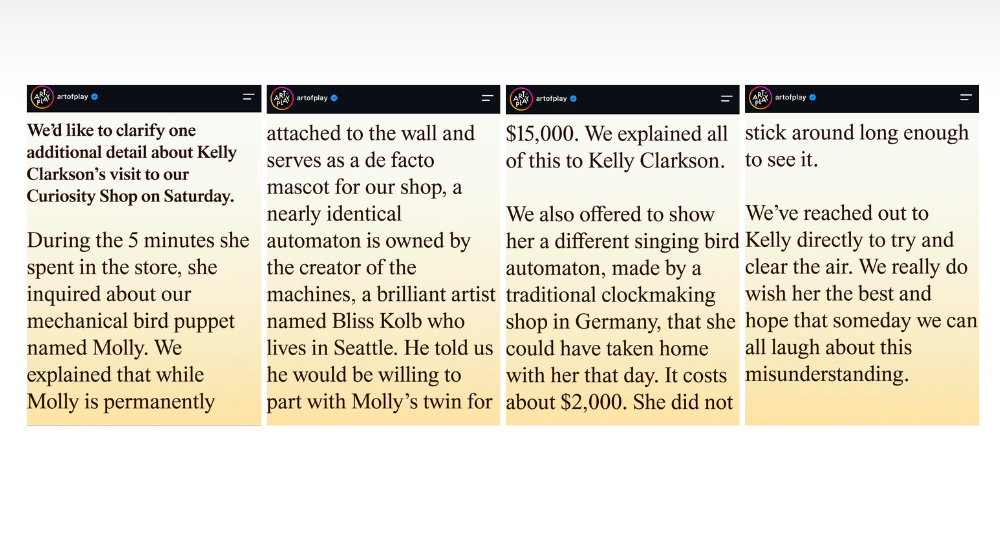
Clarkson then challenged that account, sharing an image that she said showed a $15,000 price tag next to the item and accusing the store owner of being rude and dishonest.
By that stage, the story had moved beyond an unpleasant retail experience. It had become a public dispute over whose version of events audiences should believe, and that raises a broader communications question: when does defending your version of events create a bigger reputational issue than the incident itself?
Most people following a public controversy will never know exactly what happened. They will see fragments of the story through headlines, screenshots, short clips or individual posts, often without the full context. Each additional response can therefore extend the life of the dispute and create another opportunity for audiences to assess the judgment, tone and behaviour of everyone involved.
From a reputation management perspective, being convinced that you are right does not necessarily mean that continuing the argument will strengthen your position.
Influence changes the equation
Everyone has the right to complain about poor service or unacceptable treatment, and public figures, executives and influencers are no exception. The difference lies in the scale of the impact.
When an ordinary customer has a bad experience, they may speak to a manager, contact customer service or leave a review. When someone with millions of followers publicly names a business, the consequences can be immediate. A single post can generate media coverage, negative reviews, abusive messages and significant pressure on a business within hours.
For that reason, the important question is rarely whether someone has the right to speak publicly. More useful questions are whether the criticism is accurate, proportionate, and likely to achieve something constructive.
Public criticism can be justified
Clear situations exist where speaking publicly is appropriate. Discrimination, harassment, fraud, unsafe practices, exploitation or repeated behaviour that affects consumers can all justify public scrutiny.
In such cases, visibility can help expose genuine problems and encourage organisations to address them. However, credibility still depends on how the issue is communicated.
A public figure should separate what they personally experienced from what they assume and should be clear about what can be substantiated and what remains disputed. This distinction matters because influence can bring attention to an issue, but it does not determine the facts.
The reputational risk can shift quickly
One central principle of reputation management is that audiences judge communication based on how it appears to them, not only how it was intended.
Someone may believe they are sharing an honest account of poor treatment, and many people may agree. Others may see the same exchange differently, particularly if the dispute continues after both sides have already made their positions clear.
At that point, attention can begin to shift away from the original complaint and toward questions about judgment, fairness, and proportionality.
This becomes particularly sensitive when there is a significant imbalance of influence. A celebrity or prominent executive may be able to reach millions of people instantly, while a small business may have a much smaller audience and limited resources to respond.
That imbalance does not make the business right, but it does mean you should consider the potential consequences of public criticism carefully.
What are you actually trying to achieve?
Before posting publicly, one of the most useful questions to ask is what outcome you are trying to achieve.
Is the objective an apology, an explanation, a refund, a change in behaviour, accountability or simply recognition that the experience was unacceptable?
The answer should influence the response.
If the objective is resolution, speaking directly with the organisation may be more effective. If the issue reveals a broader problem affecting other people, public communication may be appropriate. If the main motivation is anger in the moment, however, posting immediately can create a much larger issue without bringing the original complaint any closer to resolution.
For anyone with a significant audience, understanding the difference between seeking accountability and seeking public validation is important. The two can easily become confused once a dispute begins attracting attention.
Knowing when the conversation has run its course
Good reputation management also requires recognising when further public exchanges are unlikely to add anything useful.
Once both sides have stated their position, repeated responses often generate another headline, another round of commentary and another reason for the dispute to continue. They may add detail, but they do not always bring greater clarity.
This applies to businesses and individuals. Not every accusation requires a lengthy rebuttal, and not every comment needs an answer. In some situations, a clear statement followed by restraint protects credibility better than an extended public argument.
The same principle applies to public figures. Someone can continue to believe strongly that their account is correct while deciding that further public responses are unlikely to improve the situation. That decision can reflect sound communications judgment rather than any concession on the substance of the dispute.
Before you post, ask five questions
For any public figure, executive, influencer or prominent professional considering publicly criticising a business, five questions are worth asking.
These questions are not about shielding businesses from legitimate criticism. They are about protecting your credibility while ensuring your influence is used fairly, proportionately and purposefully.
Influence requires judgment
Public platforms can play an important role in accountability. They can expose genuine problems, give visibility to serious issues and encourage organisations to respond when they have failed.
For public figures, however, the size of the audience also increases the potential impact of every accusation, criticism or follow-up response. That is why judgment matters as much as the complaint's substance.
Before turning personal frustration into a public controversy, consider the post's purpose, the strength of the evidence, the likely consequences, and whether further public engagement is likely to improve the situation.
Some cases justify speaking out. Other times, the better communications decision is to state the point clearly, allow the other side to respond, and then leave the matter there.
Share